There’s more to original sources and genealogical artifacts than just diaries and letters.
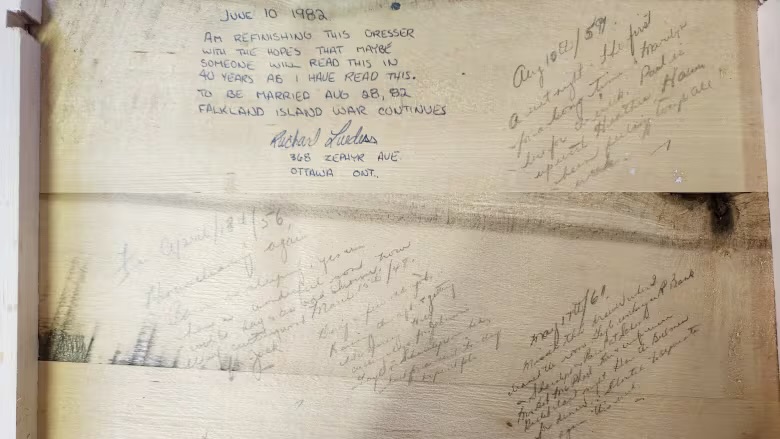
Recently, while refinishing a piece of furniture, Tim Skelly of Lanark, Ontario, discovered a series of handwritten notes on the underside of a drawer. Previous owners of the piece had left messages dating from 1942 to the most recent inscription from 1982.
Here is a link to the story from CBC: https://www.cbc.ca/news/canada/ottawa/notes-left-on-decades-old-dresser-1.7171247
The gentleman’s dresser on which the inscriptions appear is just as much a genealogical artifact as my great Aunt Rie’s pocket diary of her life in Scotland prior to her family’s immigration to Canada. The notes on the drawer provide the provenance of the item, and could be used to support other evidence of an ancestor’s residence or life events.
Richard Lueders’ inscription on the dresser from 1982 mentions his own wedding and the Falklands War – details that add interesting colour and character when writing genealogical reports for clients and family members.
And with new technologies like Transkribus, which can help decipher difficult text, handwriting and other languages, we can unlock further historical information than ever before.
Artifacts such as furniture may seem confusing to cite, but Evidence Explained, by Elizabeth Shown Mills, does provide guidelines for doing so in QuickCheck Model, Private Holdings: Artifact, page 105 of the third edition (I haven’t gotten the new fourth edition yet).
For example, my father has a cup he was given by family in Lancashire that records the name of his third great grandfather. The inscription on it reads: To Joseph Fairhurst, From A Friend.
A citation for this artifact might look something like:
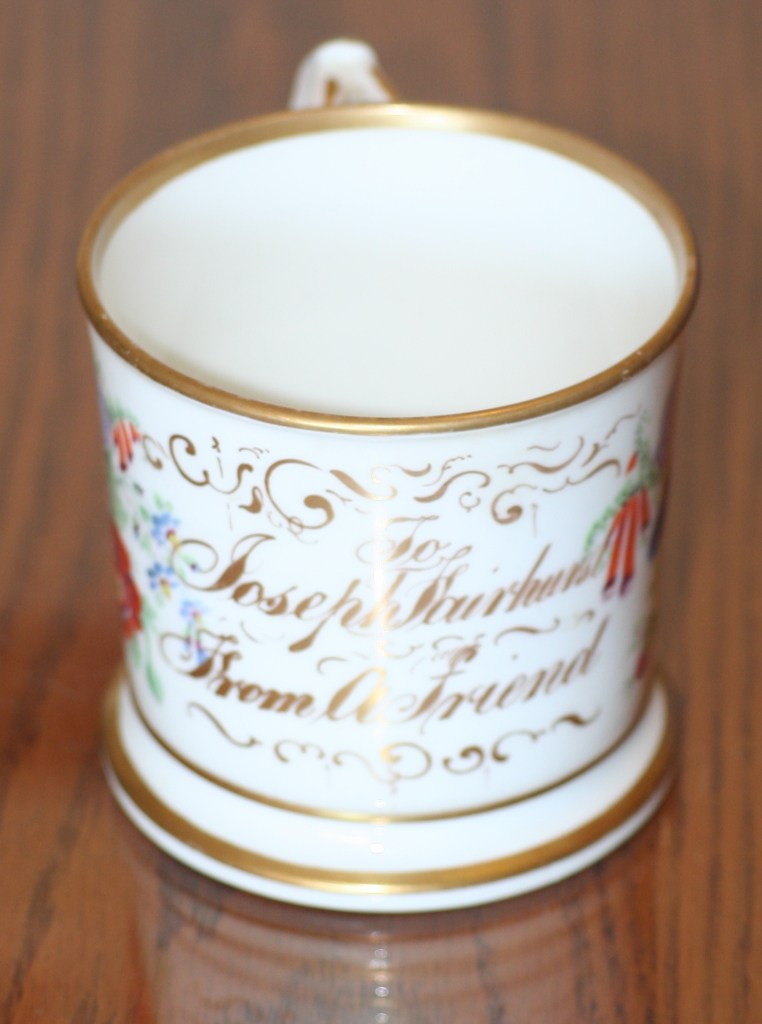
1. Joseph Fairhurst inscribed cup, personalized mug from unidentified manufacturer, in collection of Robert Frederick Gaede, ca. 1840-1885; privately held by Mr. Gaede, Calgary, Alberta, 2024. White cup with gold trim, green and red decoration and inscribed, “To Joseph Fairhurst From A Friend,” received by Mr. Gaede from relatives while visiting Widnes, Lancashire in October, 1970.
This information can be partly verified by a postcard my father sent home at the time:

Inscriptions and information can appear anywhere – from books, to photos, to furniture – so keep an eye out. The past is always calling to us. Be open and vigilant enough to listen!
 Epic Genealogy